
This prairie lizard (Sceloporus undulatus) was found lounging in this coffee cup in my sink. I have no idea how it got there. It's the second one this year, the first got stuck in a dog bowl.

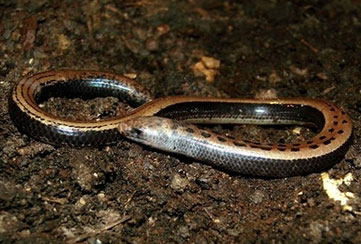 Photo by Indian zoologist Sushil Kumar Dutta |
In the report, published in the April 15 issue of ACS' Environmental Science & Technology, Michael J. Sadowsky and colleagues cite several previous studies showing that E. coli and bacteria indicating fecal contamination can accumulate and grow in beach sand. "These results indicate that E. coli originating from several sources may survive and potentially replicate in sand and sediment, possibly increasing fecal counts found on beaches," the report states. The researchers point out that while most E. coli strains are harmless, some strains do cause gastrointestinal diseases in human. Symptoms include vomiting and diarrhea, as well as more serious conditions.
The 2-year study tracked seasonal variations in E. coli in water, sand, and sediment at the Duluth Boat Club Beach in Duluth-Superior Harbor on Lake Superior. It concluded that beach sand and sediment serve as sinks and sources for E. coli from humans and waterfowl that can contribute to beach closures.
Original article: "Beach Sand and Sediments are Temporal Sinks and Sources of Escherichia coli in Lake Superior" Note: This story has been adapted from a news release issued by American Chemical Society.
 I have been visiting Lake Machado (Harbor City, CA) to photograph Reggie the Alligator; you can see photos in my MySpace blog.
 Article from KABC-7.com
FYI: The cost of security and fences around Lake Machado, and payments to alligator wranglers who failed, the total cost to taxpayers for capturing Reggie is about 180-thousand dollars. Video of Reggie can be seen on the KABC-7 website.
 Wayward Whales in Sacramento River Show Signs of Distress As Worry Over Wounds Grows By MARCUS WOHLSEN / AP / ABCNews
The challenge facing the scientists trying to push the pair back to salt water was to encourage them to move quickly without causing them anxiety that could create more physical stress. "Stressing even a healthy whale is not good. Stressing an injured whale is worse," Gorman said. More forceful techniques, such as using nets to drag the whales downstream or create a barrier across the river, could cause undue stress and threatened to harm the whales by entangling them, scientists said.
The humpbacks, which apparently took a wrong turn during their annual migration to feeding grounds in the northern Pacific, traveled 90 miles inland to the Port of Sacramento before turning around. They were making progress Monday until they reached the Rio Vista Bridge and began swimming in circles. Scientists theorized the whales started circling because vibrations from traffic on the bridge upset them, though the pair continued to circle even when traffic was halted.
 The new arrival comes five months after the birth of a major Berlin animal star — Knut the polar bear (Knut der Eisbar), who was rejected by his mother and hand-raised by zookeepers at the capital's other major zoo. So potent is Knut's appeal that zoo attendance has roughly doubled to 15,000 on average daily since his debut. He has attracted exhaustive media attention, including his own blog and TV show, and appeared on the cover of Vanity Fair.
 Article from the AP / chron.com
"These animals are so rare in nature that we are trying to breed them so we can have a stock of these animals also in captivity," he told AP Television News. The Egyptian tortoise, known as Testudo Kleinmanni, is protected by the Convention on International Trade in Endangered Species, or CITES. It is an Appendix I reptile, meaning it is afforded the highest protection. Trade in such animals, many of which are threatened with extinction, is permitted only in exceptional circumstances. The Egyptian tortoises, distinctive by their small size and golden hue, are very difficult to maintain in captivity, requiring the very warm and dry temperatures they find in their native desert habitats. Currently they are found primarily in Libya.
On Oct. 26, 2005, authorities at Rome's Leonardo da Vinci airport became suspicious when they noticed a passenger on a flight from Libya waiting impatiently for his luggage. They stopped to check his luggage, and found 275 of the rare tortoises, all but four of whom were alive, packed in a bag. Ivan Severoni, an investigator with the forest rangers, said the tortoises were destined for illegal traffickers in southern and central Italy who can command hundreds of dollars for each living specimen. "We did some investigations after we sequestered these animals, and we discovered that the people who were transporting and selling these tortoises were not aware of what they were selling, their rarity and their economic value," he said.
Breeders at Rome's Biopark (Bioparco) had tried for two years to breed the surviving tortoises, but without success until this spring. Micarelli said the Italian government was working with Libyan officials to return some of the tortoises to the Tripoli zoo.

 Article from ScienceDaily

Nakai Plateau, Laos: "The morning dawned still and chilly, exacerbated by the cold water bucket-shower that forced my breath from my body. I could hear Soutchai, my translator, in the next room, puffing and gasping from the cold as he washed. The sky grew overcast by the time we went shopping for rice, vegetables, and other food. For the next five days, we would be surveying for reptiles and amphibians in the Nakai Plateau.
My left hand really ached from the bamboo cut and IndoChinese Water Dragon (Physignathus cocincinus) bite, but I was confident it would be okay for the survey. We set off along a dusty road toward Ban Don village, where three local guides joined us. Together we drove toward the river, where a boat awaited us. As we headed upriver, there were a few kids playing on the sandbank next to an abandoned village. After an hour, the sandy banks gave way to huge boulders, creeping lianas, and overhanging trees. I took some photos of a pair of beautiful white egrets in the shallows.
About 2 km further upstream we hit a set of impassable rapids, so we stopped and located a camp site. It was late, so we had dinner. Then Soutchai and I went out exploring. After we found a couple more frogs along the main river to add to the species list, I went a few hundred metres up the dry stream-bed to have a look. Scrambling over rocks, I came to water! The river was partly subterranean.
The next three hours were like a dream – by far the best reptile and amphibian-collecting night I’d ever had. After searching just a few minutes, I found and took photos of two Asian Leaf Turtles in small rock-pools (Cyclemys dentate). I also found a huge, threatened Asiatic Softshell Turtle (Amyda cartilaginea) that vigorously tried to bite me (they can crush bone, so I had to be careful) before hurling itself into a deep pool. I caught a snake (only mildly venomous), and then went back to get Soutchai. He had to be part of this!
 Together, we walked several kilometres up the stream with our torch-lights playing through the trees, across leaf-litter, and shining into dark pools. We caught frogs I’d never seen before, and added at least 10 more species to our inventory list. There were fat, spotty bullfrogs with red armpits and thighs (which turned out to be a species undescribed to science), moss-coloured tree-frogs (Taylor’s Treefrog, Rhacophorus bisacculus), and a grey-coloured frog about 25 ft up a tree that we couldn’t identify. Soutchai dislodged it with a long bamboo stick, and I caught it one-handed as it fell (great teamwork!). There were enormous green Large-eared Rock Frogs as big as our hands, tiny red frogs called Inornate Froglet (Micryletta inornata), multiple species of brown leaf-litter frogs, an attractive-looking Striped Sticky Frog, and many more.
We returned to camp around midnight; tired, muddy, and very happy. I felt that after overcoming all of the difficult logistical challenges to conduct this survey, we really deserved to have a night like this. It had been great! I washed in the cold river by moonlight, watched the river for a while, and then clambered into my tent. I was lulled to sleep by the sound of the river and the chorus of frogs."
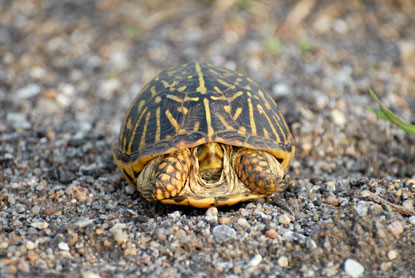
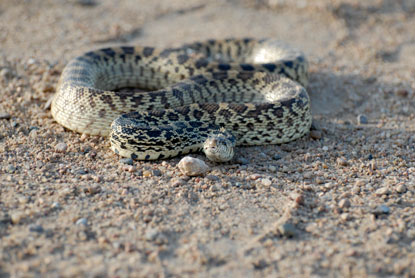
"For any nongame species not on the proposed white list, we're still proposing to allow people to keep a limited number of nongame animals for personal use; the current proposal is six," said Matt Wagner, TPWD wildlife diversity program director. "We want kids, for example, to be able to keep a pet turtle or two; we think that sort of thing is important."Wagner said a number of species currently being collected and sold, including several turtles, are identified as priority species of concern in the recently completed Texas Wildlife Action Plan. He believes prohibiting collection of these species will help their populations rebound. "There are lots of other threats out there to these reptiles, turtles, and amphibians, including habitat loss and fragmentation," Wagner said. "When you have these types of species with slow reproductive rates, it's not sustainable to have commercial collection in the wild."
 Photo Credit: Copyright Clive Martin / Marinelife
 Article from Science Daily

